
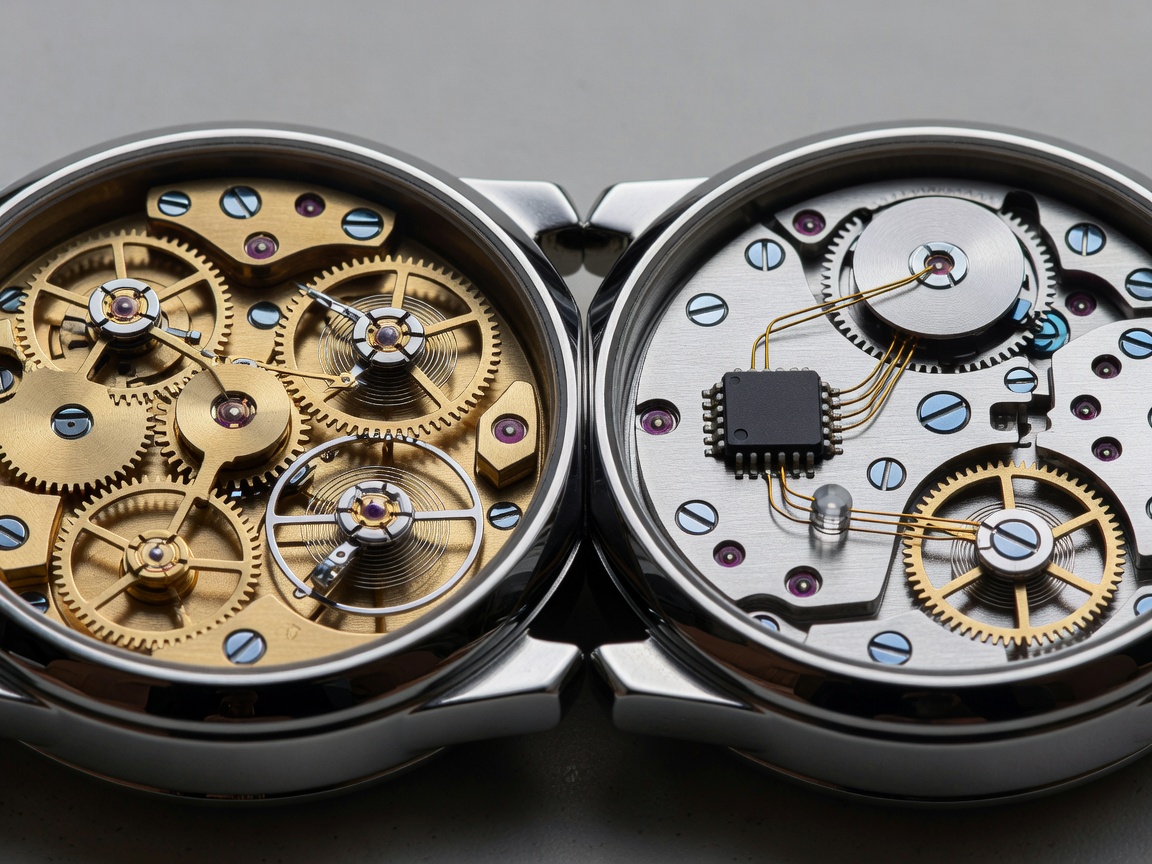
How a mechanical watch works
A mechanical movement stores energy in a coiled mainspring. A gear train releases that energy gradually, regulated by the escapement and a balance wheel that oscillates back and forth. Manual-wind watches need to be wound by turning the crown, while automatic watches add a rotor that winds the mainspring as you move your wrist.
Typical vintage movements beat at 18,000, 19,800, 21,600, 28,800 or sometimes higher vibrations per hour. Higher beat rates tend to give smoother seconds hand sweeps and better stability, but accuracy also depends on regulation and condition.
How a quartz watch works
A quartz watch uses a battery, an electronic circuit and a tiny quartz crystal cut as a tuning fork. The crystal vibrates at 32,768 times per second, the circuit divides that frequency down to one pulse per second, and a small stepper motor moves the hands. This is why most quartz watches show a seconds hand that ticks once per second.
Comparing the two
- Accuracy. Quartz is generally much more accurate. A well-regulated mechanical watch can be accurate to a few seconds per day, but a typical quartz watch will often be off by seconds per month.
- Maintenance. Quartz watches need battery changes. Mechanical watches need periodic servicing, which costs more.
- Longevity and repair. Mechanical watches can be repaired for generations. Early quartz electronics can be harder to restore if parts are unavailable.
- Character. A smooth seconds sweep and visible craftsmanship are central to the mechanical appeal.
The quartz crisis
Seiko introduced the Astron, widely credited as the first commercially available quartz wristwatch, in December 1969. Cheap, accurate quartz watches transformed the industry during the 1970s and early 1980s, a period known as the quartz crisis, which hit traditional Swiss makers hard. The industry recovered partly through luxury positioning of mechanical watches and through new brands such as Swatch, launched in 1983.
Which should you collect?
If you value craftsmanship and ritual, a mechanical watch is the natural choice. If you want reliability and a lower running cost, choose quartz. Many collectors enjoy both: a mechanical piece for occasions and a vintage or modern quartz watch for daily use. Early quartz watches from the 1970s, including Seiko Astron models, are becoming collectible in their own right.